
Build a Dunn County Former Owners Timeline
A good timeline lists each transfer in order. Record the grantor, the grantee, the instrument type, and the recording reference for every step. Start from a parcel verified in the current tax roll, then work backward one deed at a time until the trail runs out. This framework is not a finished chain for any particular tract; the names and dates must come from the actual recorded documents, not from memory or guesswork.
| Transfer Stage | Grantor to Grantee | Record to Capture | Where to Look |
|---|---|---|---|
| Latest recorded deed | Enter parties from the document | Recording date and deed reference | Tapestry EON or Register of Deeds |
| Prior acquisition | Latest grantor back to earlier grantee | Deed type and matching description | Search the prior party in the index |
| Earlier book entry | Follow the next prior conveyance | Book or index reference | Ask for deed books if online coverage stops |
| Historic parcel context | Match the old lot or tract wording | Plat, CSM or survey reference | Archives, Survey Search and recorded maps |
The timeline guards against one common error. It is easy to assume that everyone sharing a familiar surname owned the same land. Keep the legal description beside each transfer, and stop the moment the land wording stops matching the parcel.
Trace Dunn County Former Owners Through the Grantor-Grantee Index
Begin with the most recent deed tied to the parcel. Read who received it and who conveyed it. The grantor sells or gives; the grantee receives. Then search the prior owner's name in the opposite role to surface that person's own acquisition deed, and repeat the pattern deed by deed. Watch for partial conveyances. One deed may cover only a slice of a larger tract, so compare every legal description, exhibit, and recorded survey against the parcel number. An address alone often fails for older transfers.
- Confirm the current parcel PIN and full legal description from the appropriate record.
- Locate the latest deed and record its parties, date, instrument type and reference.
- Search the grantor as an earlier grantee to find how that party acquired the land.
- Compare the description and any plat or CSM reference before adding the transfer.
- Continue until the index coverage ends, then ask for the next older book or index.
- Grantor
- The party named as conveying an interest.
- Grantee
- The party named as receiving it.
- Chain of title
- A chronological sequence of recorded instruments affecting the same land.
- Reverse index
- A name-based index used to connect parties and instruments across a transfer.
Dunn County Former Owners and the Online Deed Cutoff
The Register of Deeds links to Tapestry EON for remote land-record searching. But the county's public material never states how far back that online index reaches. The earliest recorded deed dates to 1857. That gap matters. Never write a guessed cutoff into a history. And never quit a search just because the web portal returns nothing. Ask the Register of Deeds which books and indexes cover the missing years. Ask also whether a counter search is required. Older records often hide behind a name variant. They also hide behind a grantor or grantee index, a book reference, or a section-township-range description. Keep a log of dead-end searches and the date ranges tried. That log helps the office narrow the next attempt. It does so without treating an online gap as proof that no earlier transfer ever occurred. Start at Tapestry EON for the current remote-search route.
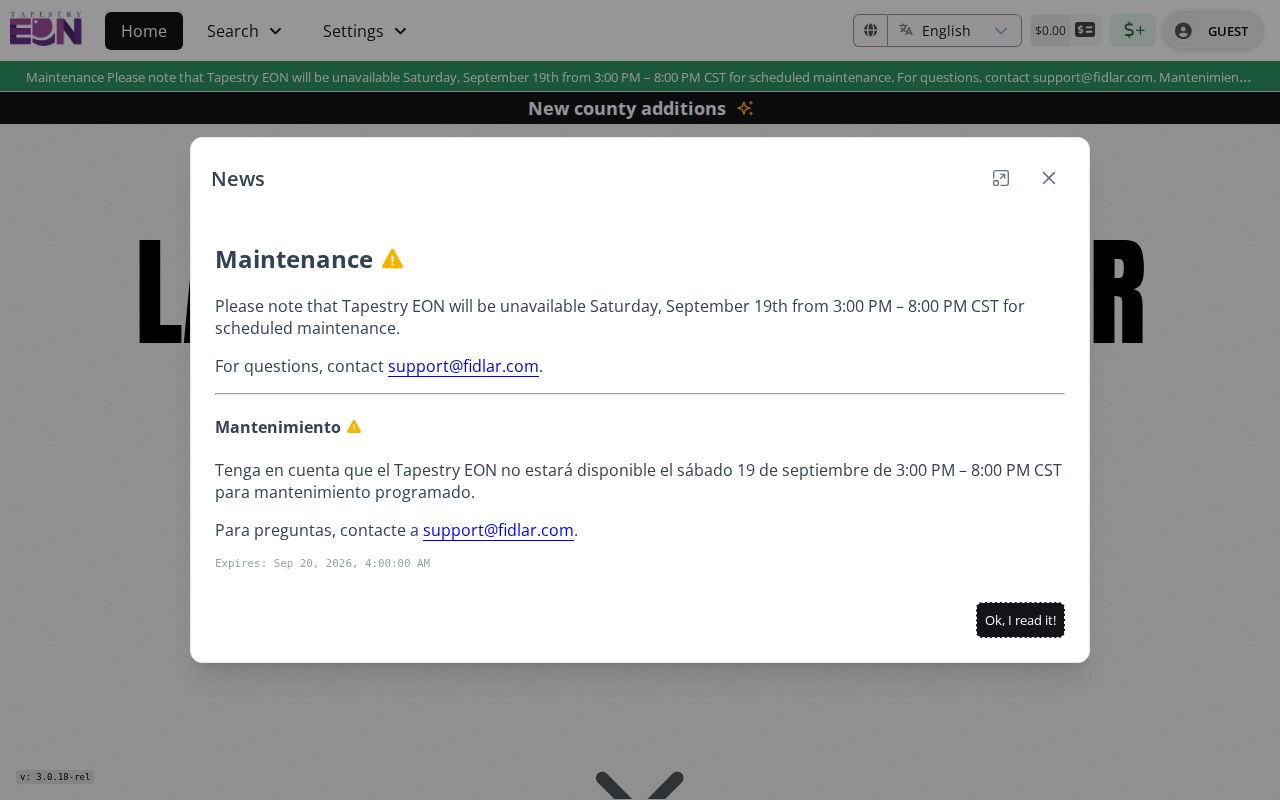
The portal landing screen is not a deed result. It shows no cutoff year and no exact search fields, so confirm coverage inside the portal or with the recording office.
Find Former Owners in Dunn County Deed Books
When the online chain ends, turn to the counter. There you will find the older deed books and indexes. Several strong fallback sources exist for historical land and family research in Dunn County. The University of Wisconsin–Stout Area Research Center and the Wisconsin Historical Society both hold documented material. So do FamilySearch and the Dunn County Genealogical Society. The FamilySearch catalog lists Dunn County deed books, grant books, and indexes. However, some image sets depend on account or center availability. These channels can surface the next reference. A catalog description is still not the deed itself. Ask the Register of Deeds how to obtain the actual instrument. Then compare its land description against the current parcel and every transfer in between. Open the FamilySearch Dunn County deed-book catalog to identify available volumes.
The catalog shows which volumes have been described and under what viewing conditions. It does not prove that every historic deed is indexed online.
Former Owners in Historic Menomonie Plats
Historic plats place former owners on a subdivision or lot before modern street numbering existed. Wisconsin Historical Society holdings include Menomonie plats from 1859, 1875, 1911, 1931, and the 1960s. The 1911 map names lots, streets, owners, Lake Menomin, and additions. An old map like this helps you recognize a forgotten description or neighborhood name. You can then link it to a current parcel search. Treat the plat as context, not as proof of every later conveyance. Follow its lot and block references into the deed index. Check whether a later CSM or annexation changed how the tract is described. An owner label on an old map did not necessarily stay the legal owner of record. Later years could tell a different story. For historic map research, use the Wisconsin Historical Society search interface to locate Menomonie plats, including the 1911 sheet.

The archive search interface leads to the mapping collections. Open the 1911 Menomonie plat record to inspect the map itself. Its old lots are useful context, never proof of later ownership.
Newspapers and Local Collections Trace Former Owners in Dunn County
The Dunn County Genealogical Society research library holds plat books, obituary files, marriage announcements, and cemetery records. It also holds newspapers, yearbooks, and family histories. Research hours run Tuesday and Friday from noon to 4. Register of Deeds genealogy appointments are handled by appointment. The Menomonie Library also points readers to historic county books and newspaper archives. These collections often reveal a name spelling. They may also surface an estate event or a subdivision promoter that sharpens an index search. Digitized newspapers add another layer. The Dunn County News covers 1866 through 1965. The Dunn County Lumberman covers 1862 through 1866. A newspaper notice may explain why an owner name changed. It still cannot replace a recorded deed or probate document. See the Dunn County Genealogical Society research collection for current holdings and hours.
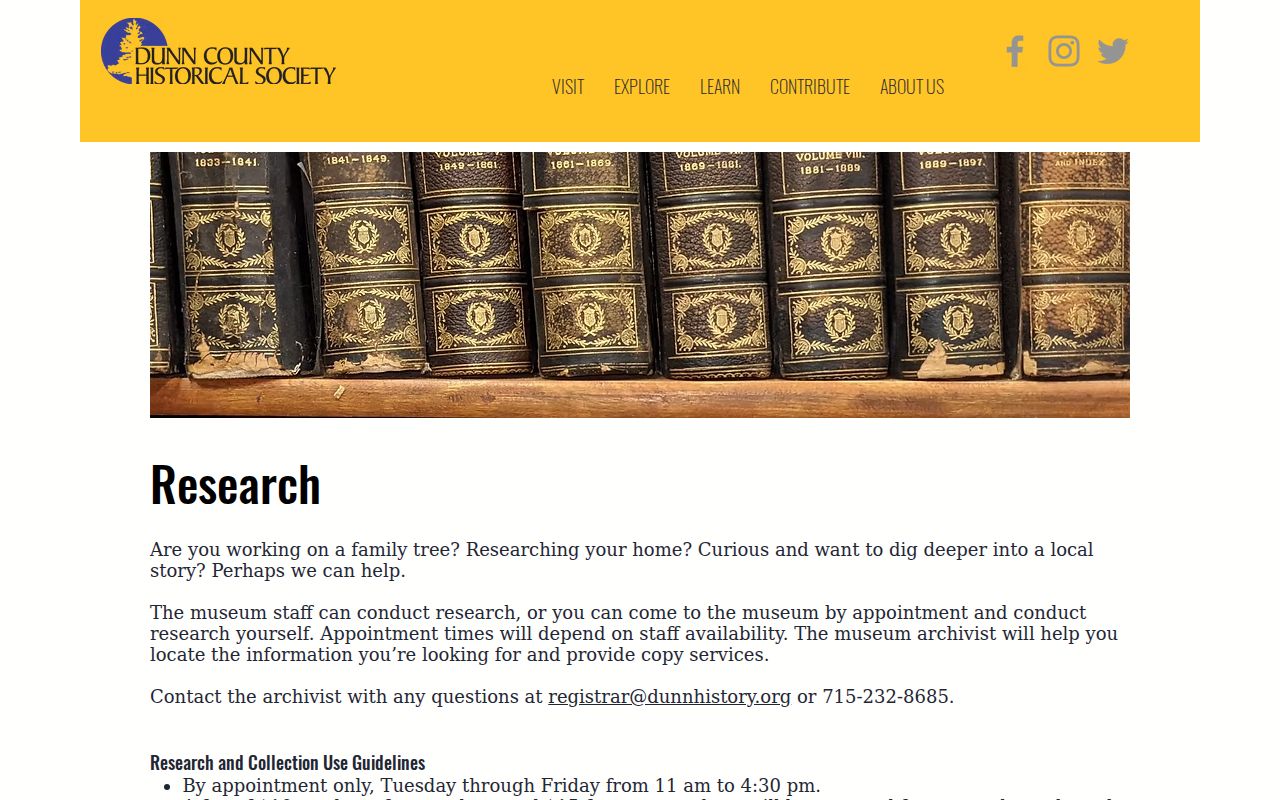
Let the archive generate leads. Then verify the parties and the land in a deed, a plat, or a court record.
Probate and Addresses in Dunn County Former Owners Chains
Not every transfer comes from a sale. Some pass through an estate or a trust. Probate orders and case records explain who held authority to sign a deed. Wisconsin Circuit Court Access posts public case information online. The Clerk of Circuit Court is the local contact. Once the court entry clarifies the event, return to the recorded land instrument to confirm the transfer itself.
Addresses pose their own problem. Dunn County runs a uniform address and fire-number system, so street numbers can shift over time. For older chains, search by deed parties, lot and block, or section-township-range rather than trusting a current street number. A former street name or a Menomonie mailing city alone never proves the tract is the same parcel.
How Far Back Dunn County Former Owners Can Be Traced
Dunn County's earliest known recorded deed dates to 1857. How deep an online search actually reaches is unknown. A researcher can still anchor a chain at that historical starting point without assuming every later owner is indexed in Tapestry EON. Gaps can exist. For any period missing from the online service, ask about books, grant indexes, counter access, and archival holdings. Note each link's source and date range.
Put prior-owner research to work on property history, title work, and lawful due diligence. Old deeds and newspapers can carry names tied to living people or former addresses. Never use those names to track someone down.
Research, then verify. A history assembled from indexes and archives is not a title opinion. Confirm each conveyance with the recording custodian and do not use owner information to harass anyone.
For the present owner of record at the start of the chain, see the Dunn County current-owner guide.